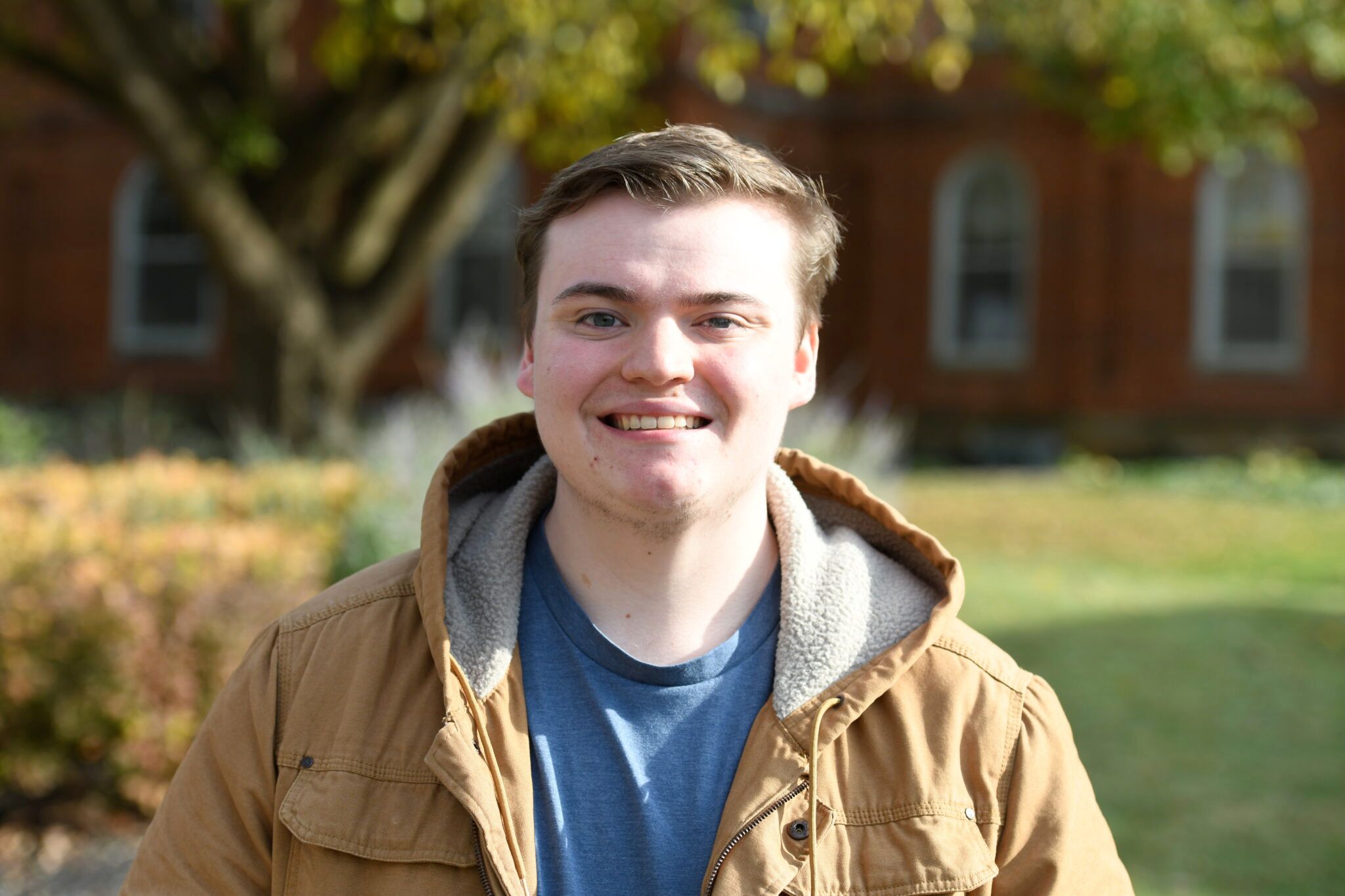
Garen Ryan is complementing his pre-law curriculum at Wilmington College by volunteering to perform village administrator duties in the 232-person municipality of Highland in northern Highland County. The village’s self-governing structure is a “bare-bones” operation with a part-time fiscal officer and police chief, the latter of whom reached out to the College seeking an accomplished student to prepare formal resolutions and ordinances for the Highland Village Council’s consideration.
Dr. Michael Snarr, professor of political science, immediately had a student he felt could successfully fulfill that role. “I recommended Garen because he is bright, responsible, interested in local politics and lives fairly close to Highland,” Snarr said. He based many of those accolades on Ryan’s leadership role with WC students lobbying on Capitol Hill, which is one of WC’s signature hands-on learning experiences. “I knew he was well-spoken in a formal and tense environment.”
Ryan is a senior from Hillsboro with majors in history and political science, and a minor in economics. He plans to attend law school after his graduation in May.
He explained that recent state legislation, which prompted his position, requires villages to provide documented proof they are supplying essential services, such as sewer and police, to continue to receive state funding — and even to legally remain a municipality. “They brought me in to help facilitate some of these processes,” Ryan said. He started the voluntary position — spending 10 to 20 hours a month — last April by attending village council meetings and learning the ins and outs of the local agenda. He’s quickly become an important ways and means staffer who coordinated the establishment of a food pantry in the local community center and helped facilitate such local projects as filling in potholes, organizing village records, working on securing street signs and writing legislation that would allow golf carts on village streets — all items of importance to the small community. Also, he’s delved into the Ohio Revised Code to ensure the village legally navigates specific laws, while also preparing formal resolutions and ordinances.
“Council tells me its priorities. It’s about the village council trying to find ways to work with the people in Highland,” Ryan said, noting aspects of his Wilmington College experience have informed his work in the village — such as preparing resolutions. These feature a structure similar to resolutions he learned to create as part of WC’s Model Arab League. The student organization has participants research the history, geopolitics and current affairs of various Middle Eastern nations and represent those entities in spirited regional and national competitions with students from other colleges.
Ryan, who also works part-time at the Highland County Records Center, has been a student leader of WC’s Spring Lobby trips to Washington, D.C. He twice led a delegation of WC students residing in Rep. David Taylor’s Ohio district to meet with the legislator or his staff to advocate on specific topics. “That lobbying experience demonstrates how you as individuals can impact policymaking,” he said, noting he’s participated in numerous Wilmington College trips to the nation’s capital. “Anyone can schedule a meeting with their legislators on Capitol Hill. It shows how every person can participate in government in some fashion.”
Also, Ryan spent last Spring Break on the College’s mission trip to Belize, where the student group worked on projects benefiting local children. He is a member of the Westheimer Peace Symposium Committee, which designs programs for the College’s annual symposium. He was heavily involved in this year’s Braver Angels panel discussion on immigration in which four diverse presenters — a “heritage” resident of Springfield, the wifeof a Mexican immigrant, a labor union advocate and a Quaker pastor — shared their stories, and perhaps confounded the audience, by finding much common ground in their beliefs.
“Giving people the opportunity to express their concerns is valuable,” Ryan said. “People really don’t want to hate each other. Most people want to find common ground.”
The Hillsboro native, who commutes to campus, enjoys the “collaborative” nature of faculty-student interactions at the College, especially in his primary areas of study. “History is something I’ve always been interested in and, once I came to the College, my interest in political science developed into a major. All of my experiences at WC have helped me develop as a person. It has been a wonderful learning experience.”
Following his graduation in May, Ryan is uncertain about his future with Highland, but is open to “staying involved in some capacity” if he can find time away from law school and if he attends one within a reasonable distance from the town he fondly describes as “a nice, tight-knit community.”
Ryan said it’s “everyday people serving and taking an active role in their communities” that can add to the quality of life of such small, rural municipalities. “This is a good position for me. It emphasizes the importance of local government and community,” he added. “It’s helped me develop an appreciation for government in everyday life.”