Mamadou Barry ’26 is heading to the University of Cincinnati College of Medicine in August. He shared the remarkable story that led him to study a pre-medicine curriculum at Wilmington College and subsequently earn a spot in UC Medical School’s 2026 entering class. Barry was an 11-year-old boy living with his mother in the family’s small West African village of Conakry, Guinea. One day, his mother fell ill, and the young boy was forced to act. First World solutions like calling an ambulance were not an option. “I drove her on a motorcycle to the hospital 15 kilometers away,” he recalled. “Since then, I wanted to be a doctor,” he added. “I knew when I grew up, I wanted to get into the medical field. I want to help other people by providing health care for them.”
His father sought a better life for his family than what Guinea had to offer and emigrated to the United States in 2001 with plans to eventually reunite with his family. He gained American citizenship and, in 2018, was able to bring them to the Cincinnati area. Mamadou spoke little English but persevered in high school by working hard and joining numerous student organizations, which gave him ample opportunities to speak with other students and become fluent in English, as he already was in Arabic, French and his native West African language, Fulani.
Barry gained traction academically over his years at Lockland High School and saw college as a possibility on the horizon. His English teacher, Kate Miller, contacted a friend she knew from her pastor husband’s church. Robert Touchton is a member of Wilmington College’s Class of 1965, a former Board of Trustees chair and one who continues to champion his alma mater.
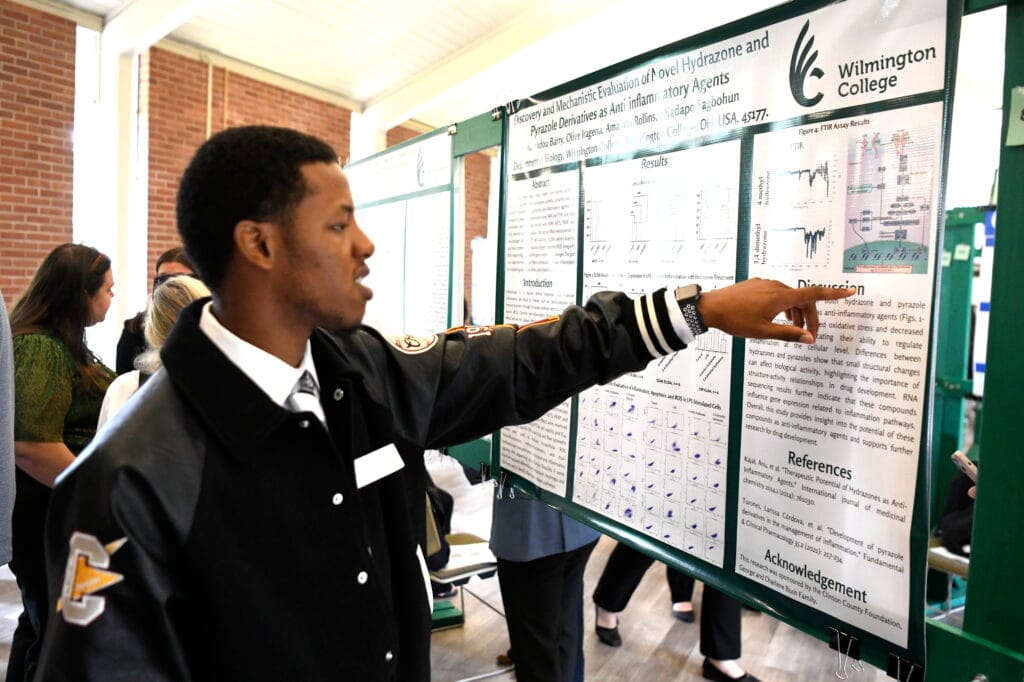
PICTURED: Mamadou Barry won the Presidential Award at the College’s annual Student/Faculty Research Forum this spring.
“I met Bob Touchton, and he talked about Wilmington College — he said the school is great,” Barry said. “Now, this is my place.” Both Miller and Touchton attended his graduation in May.
From the start, Barry found support at the College, starting with Chip Murdock, assistant vice president for student affairs, who helped him navigate the campus upon his arrival. Based on his good experience with student organizations in high school, he embraced involvement with Scholars of Promise, Black Student Initiative and Tau Kappa Beta (TKB) fraternity. He especially appreciated those groups’ service components.
Barry successfully applied to become one of the initial residents of the Art Brooks MVP (Mission, Values and Purpose) House, where he and other like-minded students devised community service projects and enjoyed meals prepared with a taste of their native lands.
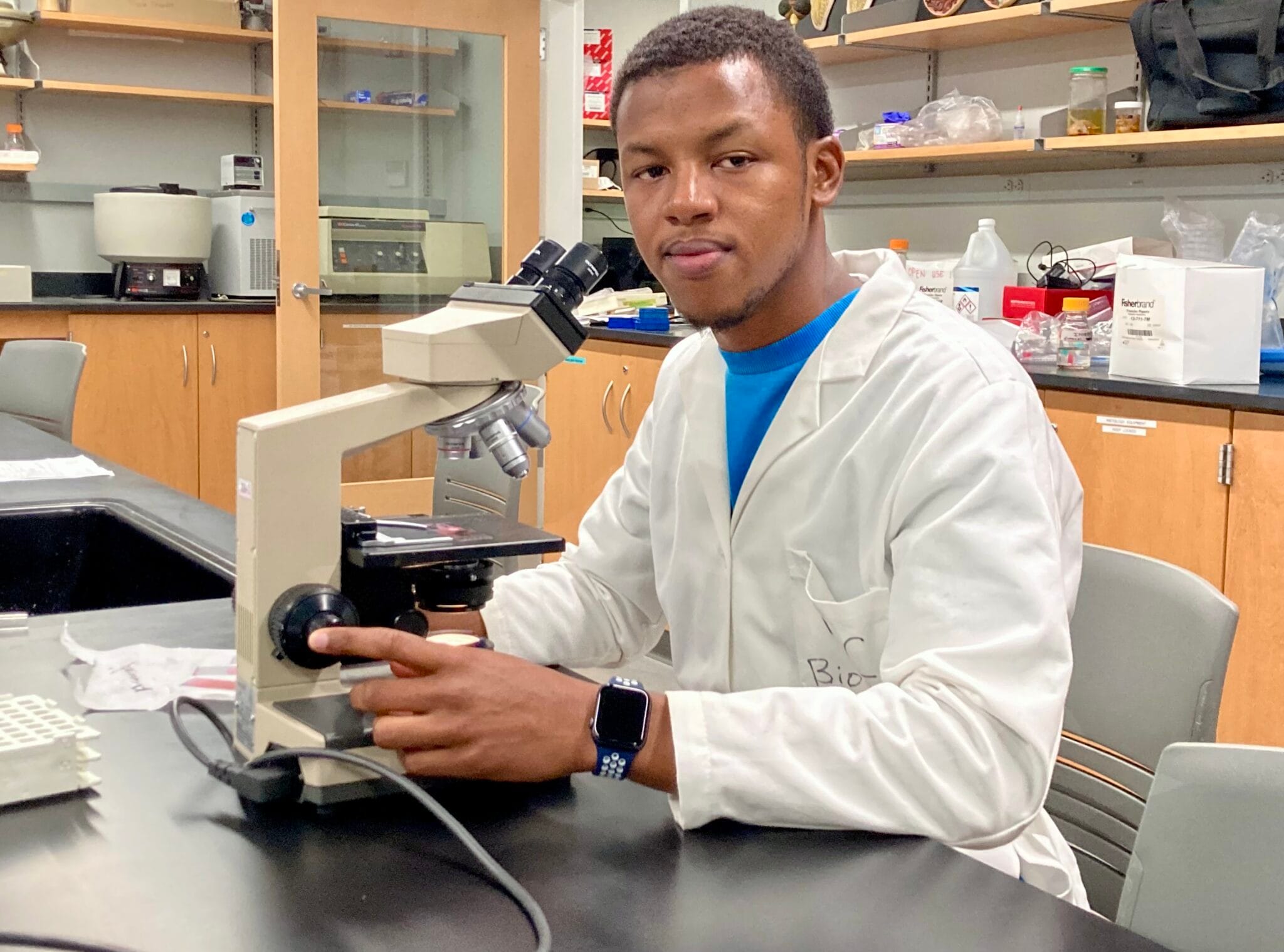
Barry felt right at home in the Center for the Sciences and Agriculture as a biology major and chemistry minor. He was impressed with the equipment and laboratories available to an undergraduate student and flourished in a research laboratory environment. After his sophomore year, he received a coveted internship with Hikma Pharmaceuticals in Columbus, where he conducted some 600 hours of research. Also, he engaged in high-level research in the Cell Culture Lab with Dr. Oladapo Fagbohun, associate professor of biology at the College.
Indeed, Barry was listed as an author of a research presentation with Fagbohun, Dr. Amanda Rollins, assistant professor of biology, and WC junior Olive Iragena, titled ”Rationally Designed Hydrazone and Pyrazole Scaffolds as Dual-Acting Anti-Inflammatory and Antioxidant Candidates,” which earned Barry and Iragena the Presidential Award at the College’s Research Forum this spring.
Fagbohun cited Barry as an “exceptional student” whose academic discipline and intellectual curiosity set him apart in every course he took from the professor. “Mamadou brings a rare combination of focus, humility and determination to his work, elevating the learning environment for his peers,” he said. As a student researcher, Fagbohun said Barry demonstrated “remarkable scientific maturity” during his final semester practicum, the Presidential Award-winner, in which he executed experiments on the anti-inflammatory properties of newly synthesized hydrazones and pyrazones, in which they determined the structures using NMR, and carried out differential genomic changes that were expressed in macrophages tested with these compounds.
“He analyzed data rigorously and communicated his findings with clarity,” he added. “It was a testimony to both the quality of his work and the professionalism with which he presented it.”
Barry greatly appreciates the laboratory opportunities he had at WC “since day one,” noting that many schools don’t have such labs and research opportunities, especially available to undergraduates. “It’s been an eye-opening experience for me. I didn’t think going to this small school would offer so many opportunities,” he said. “I was interested in biology and chemistry research, and the opportunities at Wilmington have been very helpful for me. I’ve learned a lot. I love being in the research lab — I come here to study day and night.”
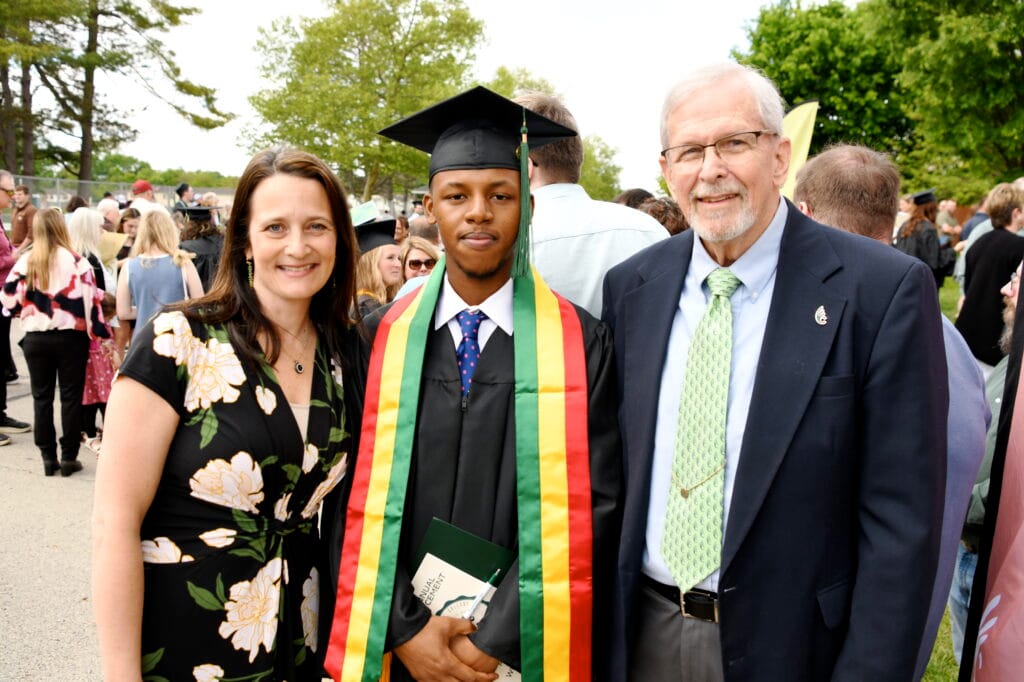
PICTURED: Following the Commencement ceremony, Mamadou Barry greets Kate Miller, his high school English teacher, and Bob Touchton, who initially told him about Wilmington College.
He described graduating from WC as “a dream come true for me. Getting a degree makes me feel like I’ve gotten a lot in my life, and now I’m going to medical school. Wilmington has prepared me well to compete at an institution like UC Medical School. I’m so excited. I’m really grateful to Wilmington College and all my professors.” The first in his family to go to college, Barry sees how education can change family trees. “When my little brother and family see me get these opportunities, they know they can also do it,” he added. Looking back on where he started and where he stands today, Barry channeled the 11-year-old boy in Guinea with an ailing mother, fearless with an important task to accomplish. “I’ve always had the courage to become what I am today.”
Fagbohun believes Barry will be successful in a medical career, noting that he possesses all the qualities that define a future physician. “Mamadou has strong scientific grounding, critical thinking, empathy and a deep commitment to service,” he said. “He is exceptionally well-prepared for medical school and will no doubt become a compassionate and impactful physician.”
TOP PHOTO: The Biology Research Lab was a regular locale for Mamadou Barry, who said, “I come here to study day and night.”