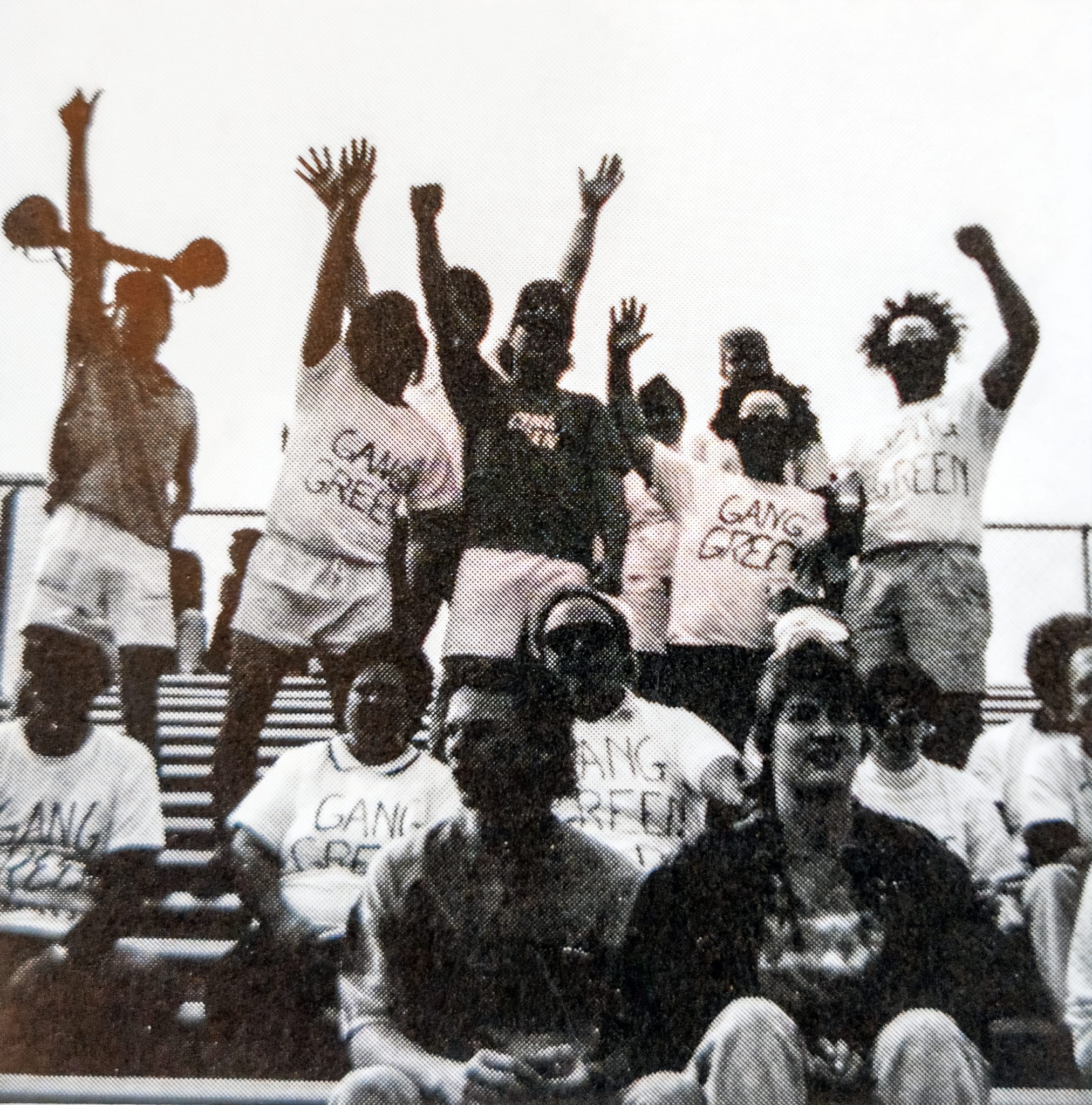
Some 46 years after the spirit group Gang Green formed during the football season for the ages, Wilmington College this fall is bringing back the storied student spirit group for Homecoming and beyond. The following is a story written in 2010 on the 30th anniversary of the football team’s run for the National Championship in 1980. Two of the major contributors to this story are no longer with us: Jeff Moore and Mark Heffernan. This retelling of Gang Green’s story is dedicated to their memory.
Each year as summer wanes and the air takes on the crispness of fall, Peggy (Roads) Sturdivant ’82 finds herself reflecting upon an autumn now some three decades in the past.
It was 1980 and her mind’s eye revisits the season for the ages when Coach Bill Ramseyer’s Fighting Quakers football team — along with the campus and community — made a run to the NAIA National Championship game. Sturdivant, a cheerleader, still marvels at the camaraderie, passion and good vibrations evident in the group Gang Green, which constituted an epicenter of infectious school spirit.
“What still strikes me the most is the closeness that we all felt as we joined together to take a wonderful journey that season — we were like a family,” she said. “It was just wonderful how the entire campus came together.”
One of Gang Green’s ringleaders, Mark Heffernan ’82, recalls lamenting — with Pamela (Stalnaker) Jenkins ’81 and Steve Ohnsman ’82 during a resident advisers’ training session in August 1980 — students’ weekend exodus from campus and lack of spirit at games.
They agreed to be proactive in addressing the “dire need” for a football cheering section, as the upcoming season had great potential for success.
“We started kicking around names for our group — ‘Quaker Crazies, The Green Machine, Gang Green,’” he said. “We stopped walking, stopped talking and just stared at each other with big smiles. We all realized we just named our cheering section.”
Gang Green members not only had their own ever-growing section in the stands, but members even infiltrated the sidelines, as Jeffrey Moore ’83 served as a student athletic trainer. In fact, he was among only a handful of insiders privy to one of the great motivational stunts in college football.
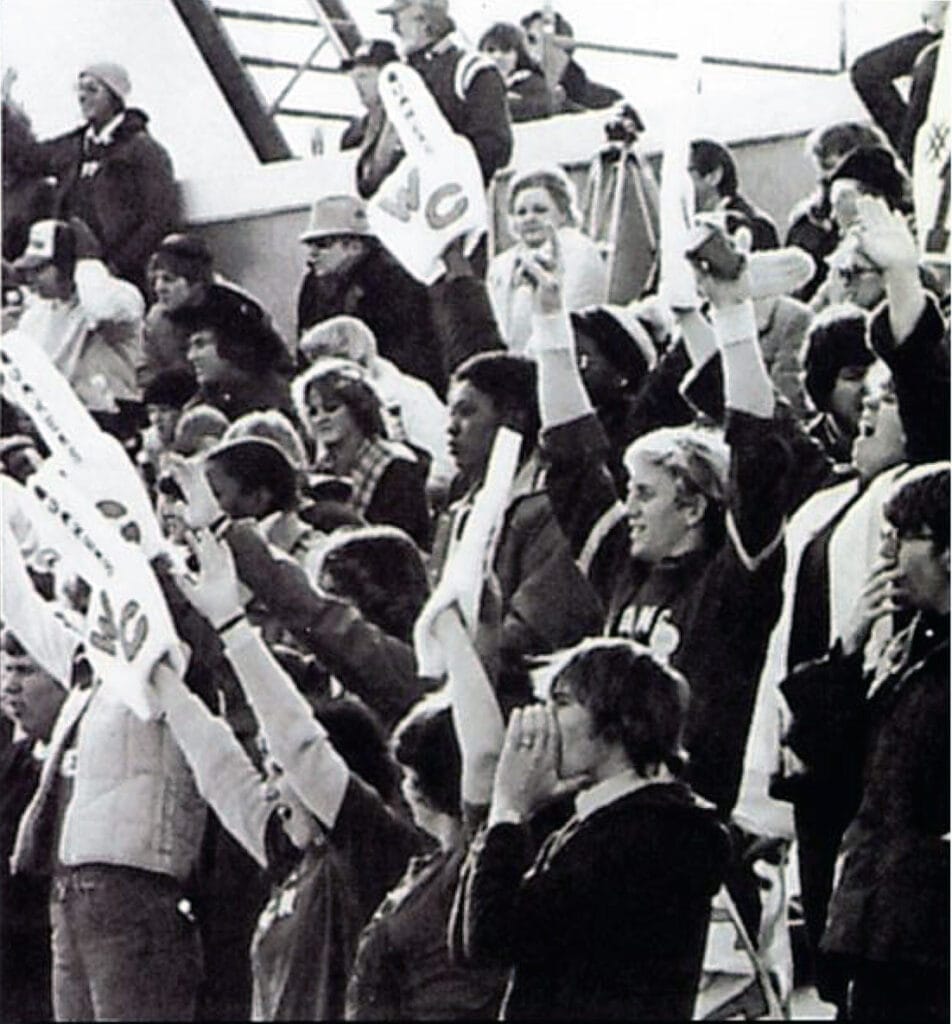
PHOTO: Gang Green members cheer on the 1980 football team.
When the Fighting Quakers faced defending NAIA champion Findlay College in its 1980 season opener, word filtered to the team that its green home jerseys were “missing.” Ramseyer sent the team into pre-game warm-ups wearing their white road jerseys, which were the same color as Findlay was wearing.
“The teams came out and the Findlay coach was obviously upset — I believe he wanted us to forfeit the game,” Moore recalled, noting he thinks the opposing coach and officials’ concern was assuaged when they were led to believe that WC trainers were gathering dark practice jerseys for the team to wear.
“What actually was happening was the trainers were placing the green game jerseys on hangers at the players’ lockers,” he said. “Emblazoned on the front of each jersey in bright ‘Findlay orange’ was ‘BEAT FINDLAY.’
“When I returned to the sidelines after helping to ready the jerseys, you could hear the crowd buzzing about both teams wearing white jerseys — it was difficult not to have a big grin on my face,” Moore said.
“A few minutes later, the Fighting Quakers returned to the field and the stands erupted when they saw the BEAT FINDLAY jerseys,” he added. “Across the field, the visiting fans were silent. I can’t imagine what the Findlay players were thinking when taking their stance across the line from our players and seeing BEAT FINDLAY on every play.”
Ramseyer admitted that, in coaching, he always was a “gimmick person” in attempts to obtain a psychological edge.
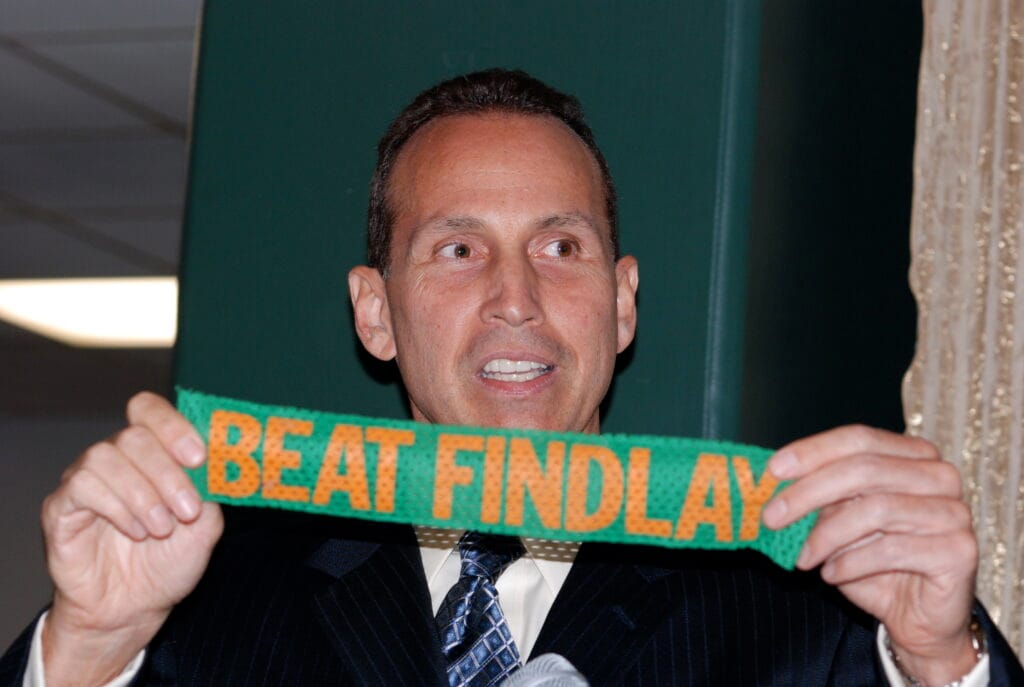
PHOTO: Ed Minor, a member of the Quakers' 1980 football team, displayed the orange "BEAT FINDLAY" patch secretly placed on each player's jersey before the big game.
“It was a spectacular victory that led to the fantastic year,” Moore added. “And the more the team won, the more students stayed on weekends. The campus became more vibrant. Even people who had little interest in athletics were in the stands cheering their friends on.”
Gang Green’s game day routine involved what Jenkins described as a pre-game “pray meeting” either at the Sigma Zeta house or Ohnsman’s residence director’s apartment in Austin Hall.
Ohnsman recalled Ramseyer inquiring as to the nature of their pre-game pray meeting/gathering/party.
“I may have told him it was just a bunch of crazy, nutty kids getting pumped up to support the team,” Ohnsman said. “I made so many great friends through that (Gang Green) experience — it was great!”
One of Gang Green’s most redeeming features was that it was not intent upon being an insular, exclusive club; rather, it constantly welcomed others to jump on the bandwagon. In fact, that philosophy reflected Ramseyer’s efforts to enlist the support of students, faculty, alumni, the community, etc.
“Success rarely is achieved on an island,” the coach said. “It takes a united effort by many groups and constituencies. From day one, we worked to achieve that relationship — certainly in 1980 it all came together.”
Jenkins added, “One of the things I loved about Gang Green is we became a family — and a family that wanted to grow.”
And grow it did. In fact, WC President Robert Lucas became an honorary Gang Green member. Heffernan recalled Lucas asking how he might secure one of the Kelly green T-shirts with white block letters that identified its wearer as a Gang Green member.
“I can now confess that I charged President Lucas double ($10) for the shirt off my back,” he said. “To President Lucas’ credit, he wore his Gang Green T-shirt over his dress shirt and tie and under his sport jacket to every game — what a great guy!”
Indeed, Ramseyer praised Lucas as a president who “promoted pride and made everyone feel they were important to the success” — not only success in winning games on the football field but success in every area of the College.
“Bob Lucas saw very vividly how a successful athletic program can instill pride in every area of the College,” he added, noting the president “led the charge” in 1980. “I remember it like yesterday, him wearing his Gang Green T-shirt to the games.”
Lucas’ implicit endorsement of all things Gang Green came in handy when the group elevated its presence to an unprecedented level on the eve of the opening round playoff game versus Hanover College at Wilmington.
Heffernan reminisced that both teams attended a banquet in Pyle Center on the evening before the game. Meanwhile, Gang Green was at the Sig house — with a plan.
“As night fell, we gathered firewood (probably from a discarded Sig couch) and quietly marched over to Pyle Center,” he said. “Positioned at the main entrance next to the cast-iron bell, we started a bonfire, began cheering and, with bullhorn (borrowed that day from the Wilmington Fire Department) in hand, I requested that Coach Ramseyer join our impromptu pep rally.
“Immediately, we saw the drapes in the dining hall move back and forth as players, coaches and administrators peeked to see what was causing all the commotion,” Heffernan added.
“Soon a smirking Coach Ramseyer made his way outside thanking us for all the love and support. He politely informed us that President Lucas thought it would be best if we moved the party back to the Sig House, which we did without resistance.
“Our mission had been accomplished,” he said. “Not only did the Fighting Quakers know we had their backs going into the next day’s playoff game, but so did the Panthers.”
Ramseyer shared his recollections from the evening. “After the meal, there was a brief program and, while Dr. Lucas was addressing the group, all of a sudden you could hear Gang Green leading a throng of students in chants supporting the team,” he said.
“When I went to the window to see what was going on, there, right outside Pyle Center, was this impromptu pep rally and bonfire,” Ramseyer added. “What a psychological edge this gave us over Hanover as we prepared to play our first-ever national play-off game the next day.”
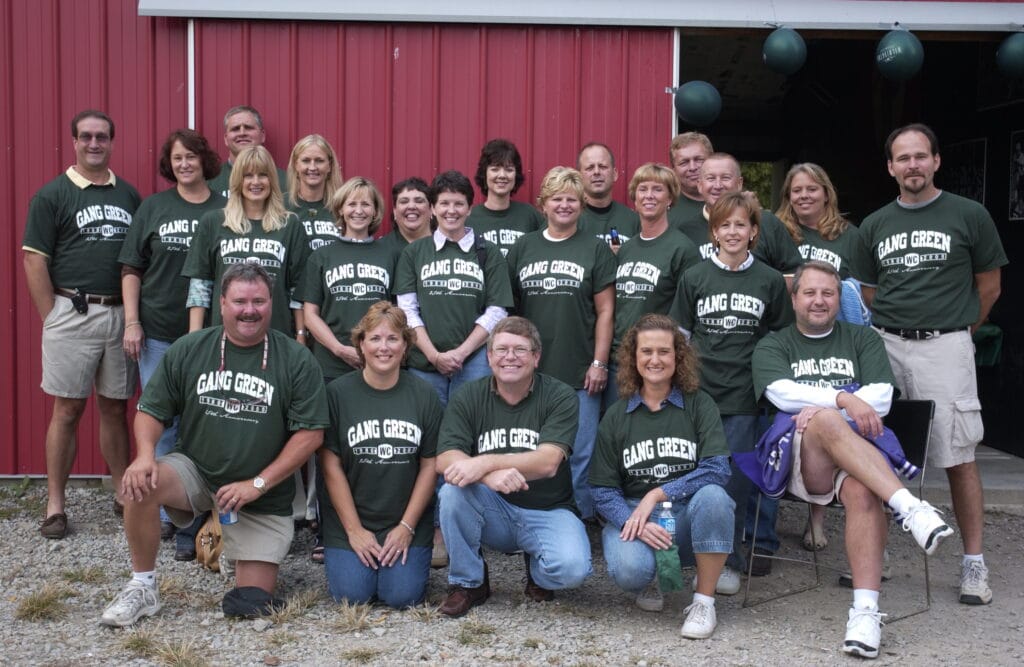
PHOTO: The 1980 Gang Green held a 30-year reunion in 2010.
The Fighting Quakers claimed a four-overtime victory and continued winning en route to the championship game against powerful Pacific Lutheran. WC’s championship run ended at the doorstep of the title.
But the spirit of Gang Green didn’t end there. Larger student crowds supported other WC sports, Aggies’ events and the arts. In fact, Heffernan recalls a number of football players attending Gang Green members’ performances in College theatrical productions. “It might have been their way of saying ‘thanks’ for all the support,” he said.
Those good feelings remain with Jenkins as she looks back 30 years. “What a rare experience to be a part of a group like we had,” she said. “That was the type of campus we had then. The excitement of our football team lit the fire for Gang Green and it was infectious — everyone caught it. “The great friends, coaches, good times… It was the best time of my life.”
Sturdivant cites Ramseyer’s interest in team ownership transcending the athletics side of campus to include the greater College community. “Coach always made everyone fell like an important part of the ‘team,’” she said.
When Gang Green members — now mostly in their early 50s — have gotten together, as they did in 2005 at the 25th reunion, the ensuing years since 1980 easily melt away. “I am still friends with many Gang Green members,” Sturdivant said. “It does not matter how long the time period is between visits; some relationships seem like we just were together yesterday.”
Heffernan added, “Gang Green has gone far beyond football. Neither time nor distance can ever separate us from those memories and friendships forged.”
Moore echoed those sentiments. “I believe Gang Green’s greatest gift is that we all became better friends,” he said. “One of the reasons I chose to attend Wilmington College was the friendliness of everyone I met on my visit. I believe Gang Green changed us from just classmates to a community.”
For Heffernan, who, in 2005, produced an outstanding documentary of the season for the ages, titled Run for Glory, that watershed year was a symbiotic experience that proves the interconnectedness of so many people and experiences. “I like to think that Gang Green happened because of the 1980 season, but also that the 1980 season happened because of Gang Green.”
Giving Ramseyer the last word on Gang Green: “My hat is off to all members of Gang Green. I love them all and I want each of them to know and understand how important they were to the success of the 1980 season. “They were our 12th man.”
BY RANDY SARVIS
TOP PHOTO: Members of the original Gang Green are pictured in 1980.