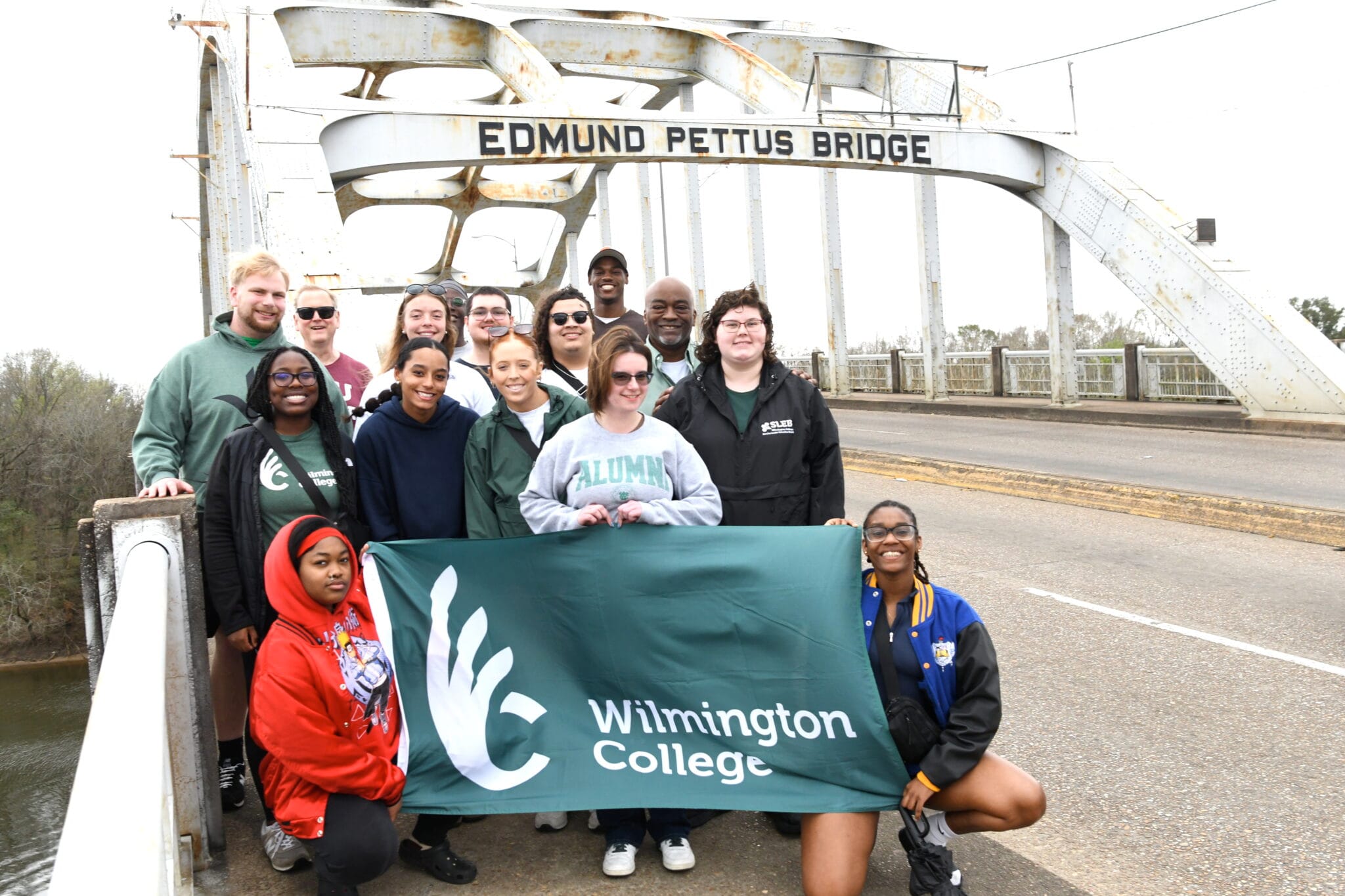
On March 7, 1965, Alabama Highway Patrol officers violently attacked African Americans with batons, dogs and tear gas on the Edmund Pettus Bridge in Selma, Alabama. The citizens were peacefully protesting for their constitutionally guaranteed civil rights during a 54-mile march from Selma to the state capital, Montgomery. Passage of the Civil Rights Act of 1964 legally ended segregation in the Jim Crow South, but enforcement often was another matter. An emerging civil rights leader who would become an iconic U.S. Congressman, John Lewis, was struck in the head, suffering a broken skull and a severe concussion.
The violent day became known as Bloody Sunday and sparked a national outcry that questioned the nation’s claim to be a beacon of freedom and justice. It served as a key moment in the American Civil Rights Movement, highlighting racial injustice and helping lead to the passage later that year of the 1965 Voting Rights Act.
Some 61 years later, on March 8, 2026, Wilmington College students participated in Jubilee Sunday and walked across the infamous Edmund Pettus Bridge.
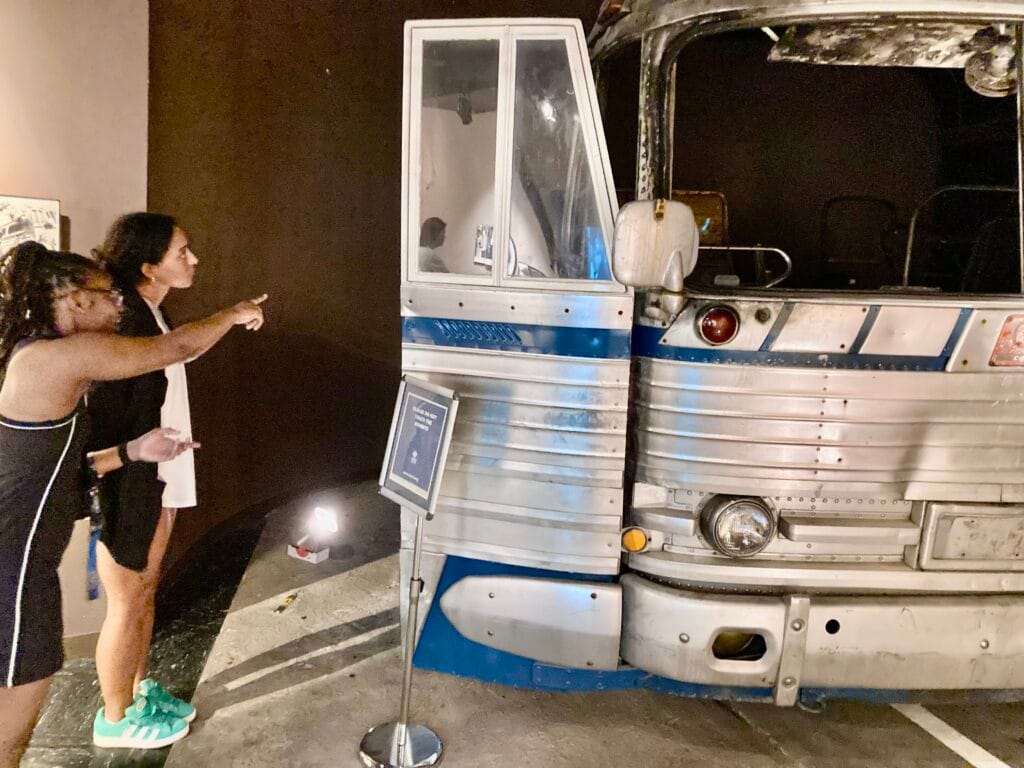
PICTURED: At the Birmingham Civil Rights Institute, Jaineen Smith (LEFT) and Kyla Rush view part of the burned-out Greyhound bus carrying Freedom Riders that was firebombed in 1961 near Anniston, Alabama. Passengers were trapped inside the burning bus and beaten when they attempted to exit. The event drew national publicity and prompted new laws banning racial segregation on interstate travel.
The 11 students, accompanied by five staff members, spent a portion of the College’s Spring Break on an intensive tour of Civil Rights-related landmarks, museums and memorials in Atlanta and Alabama. It is one of three Civil Rights-themed tours offered in alternating years that also visit Memphis, Jackson, MS, Little Rock, AK, Greensboro, NC, and Charleston, SC. Known as “Chip Trips,” they are led by Chip Murdock, assistant vice president for student affairs and director of the Office of Mission, Values and Purpose. Murdock also leads an annual trip to Washington, D.C., and service trips to Chicago, Detroit and rural Kentucky. The tours, which are open to all students regardless of their ability to pay, take learning another step beyond the classroom to “being there.”
“I don’t intentionally want to stir up White guilt or Black rage from these sites we visit, but you can’t unsee the stuff that you see,” Murdock said. “This is history, an important part of history. Yes, it’s heavy, but we go there for a reason — and we go there together as family.”
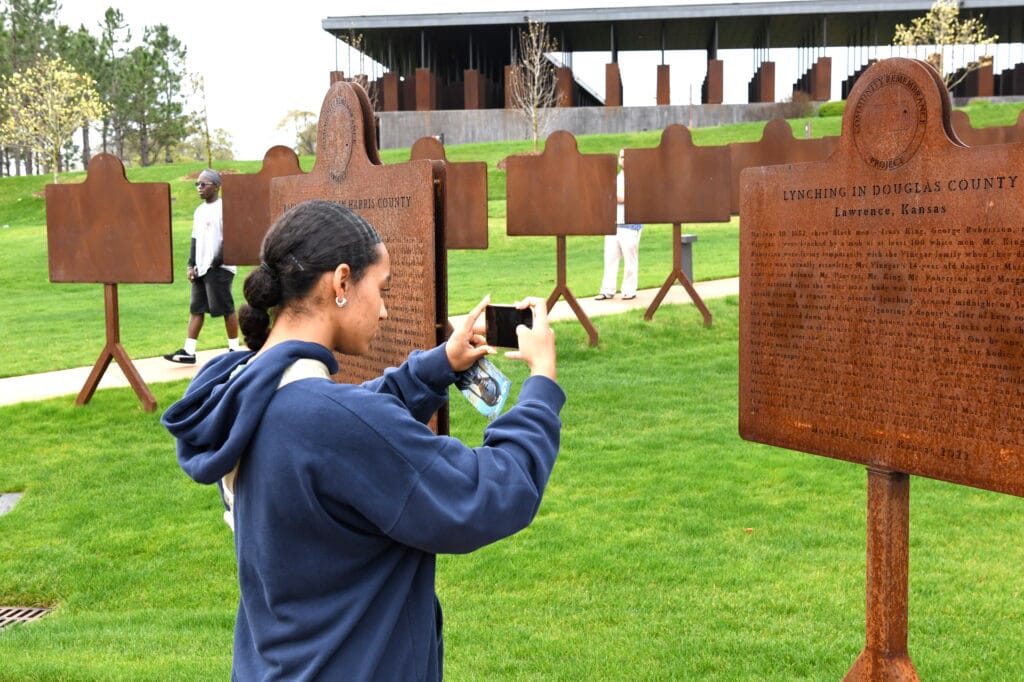
PICTURED: Kyla Rush photographs markers telling the stories of individual lynchings at the National Memorial for Peace and Justice in Montgomery.
President Corey Cockerill’s Atlanta visit to meet with alumni coincided with the “Chip Trip,” so she joined the group on several of their stops after the contingent joined her at the alumni reception the previous evening. She spoke of the College’s hallmark for providing students with ”high-impact experiences” that both reflect the College’s values and complement traditional learning.
“Sometimes you have to leave your zip code for exposure to these kinds of things,” Cockerill said, noting such experiences can be life-transforming. “That’s the Wilmington way! It’s education at its best, getting out of your comfort zone and being receptive to new things.”
This year’s tour featured stops at the Birmingham Civil Rights Institute, the National Memorial for Peace and Justice and the newly opened Montgomery Square in Montgomery, the Edmund Pettus Bridge in Selma, the Rosa Parks Museum in Montgomery, the Legacy Museum at Tuskegee University, the Tuskegee Airman National Historic Site and, in Atlanta, the Jimmy Carter Presidential Library, Martin Luther King Center, Ebenezer Baptist Church and the Center for Human and Civil Rights.
Upon entering the displays at the Birmingham Civil Rights Institute, the WC contingent encountered an installation featuring a pair of drinking fountains, one labeled “whites” and the other “colored.” Senior De’Anta Sanan, an African American student from Nicholasville, KY, defiantly pretended to drink from the whites-only fountain. In the Jim Crow-era South, that act could have led to sanctions ranging from garnering a verbal reprimand, being asked to leave the venue or receiving a disorderly conduct charge, to suffering a beating and even being lynched.
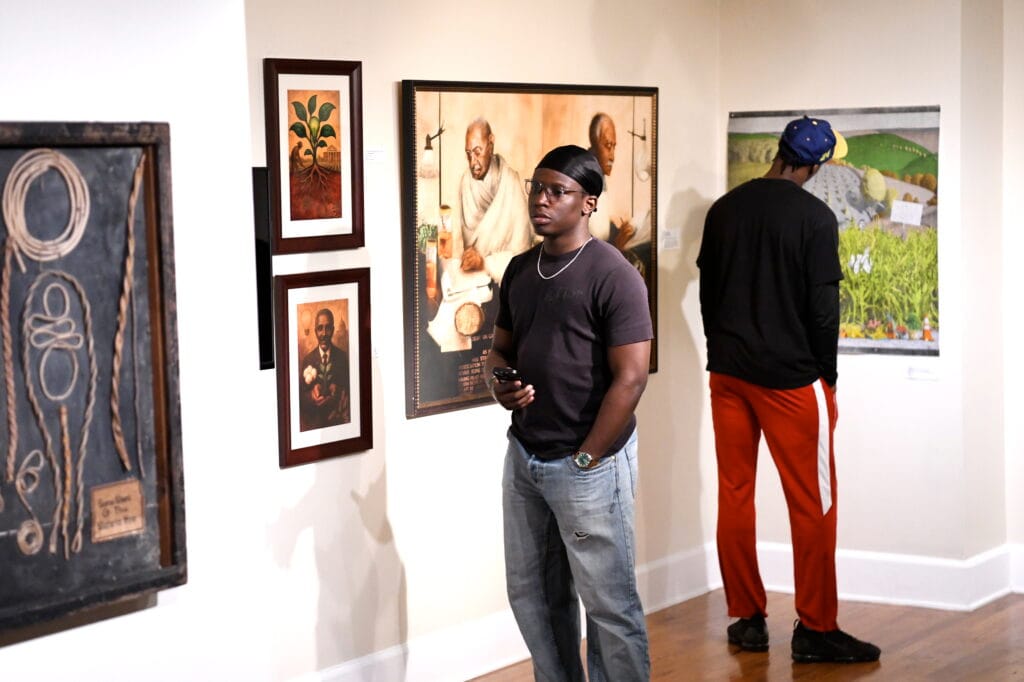
PICTURED: Meagel Amollo (LEFT) and De'Anta Sanon view an exhibit of folk art at the Legacy Museum on the campus of Tuskegee University in Alabama.
The Tuskegee Institute documented 4,733 lynchings in the United States between 1882 and 1968. The vast majority of victims were African American men in the South. These lawless public executions, often by hanging, for which victims received no due process of law, were many times based on trumped up charges or such trivial offenses as “drinking from a white man’s well, threatening to report white men for whipping his neighbors, complaining when a white shop owner refused to serve him, asking a white woman for a drink of water or for suing the white man who killed his cow.”
Montgomery’s National Memorial for Peace and Justice — known as the “Lynching Museum” — proved to be an especially moving stop on the Spring Break Civil Rights Tour. The six-acre site features multi-levels and includes the names of victims engraved on some 800 Corten steel monuments, one for each county in Southern states where a racial terror lynching took place. The viewer soon realizes each monument is an abstract image of a hanged person, and the installation moves from providing an eye-level glimpse of the victims’ names to a much lower-angle view symbolizing the crowd watching a lynching.
No one knows exactly how many lynchings occurred, and those unnamed victims are also honored at the memorial. Inscribed behind a waterfall are the words: “Thousands of African Americans are unknown victims of racial terror lynchings whose deaths cannot be documented, many whose names will never be known. They are all honored here.”
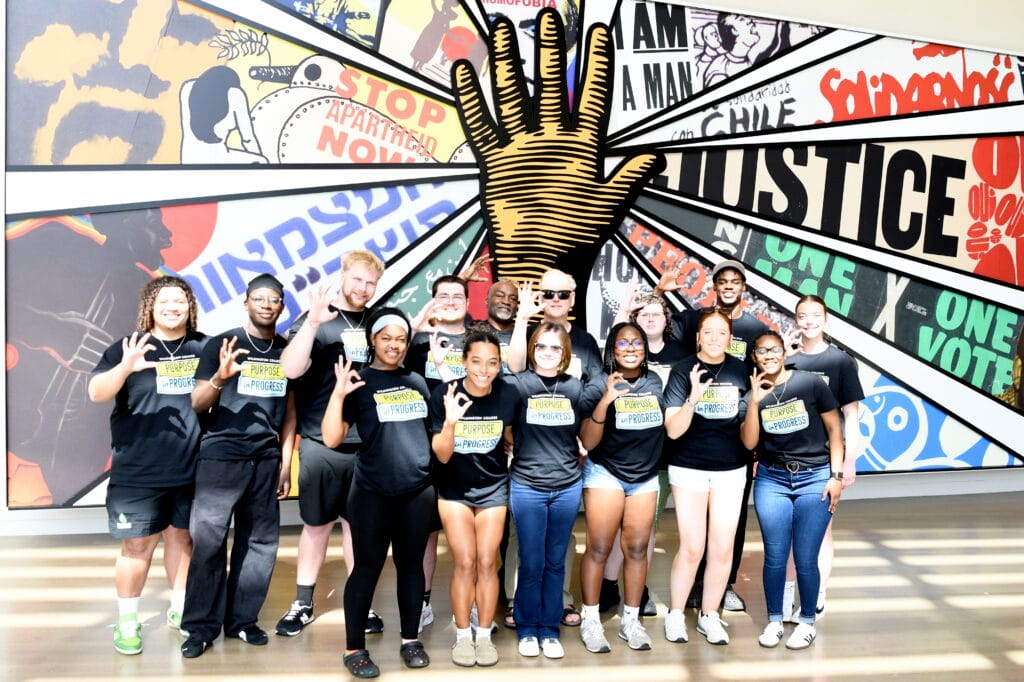
PICTURED: The WC group poses for a group photo at the Human and Civil Rights Museum in Atlanta. Pictured from the left are: FRONT ROW — KaMylia Mann, Kyla Rush, Brittanie Clair, Rose Bothast-Revalee, Gracie Blackburn and Jaineen Smith; BACK ROW — Darrick Perdue, Meagel Amollo, Jack Robinette, Kellen Strayer, Chip Murdock, Daniel McCamish, Emily Winkleman, De'Anta Sanon and Ashton Harris.
Senior Jaineen Smith, an African American student from Springfield, sat silently in reflection as the water cascaded. “Looking at the waterfall made me have a moment to think about what my people went through,” she shared. “I thought about how I, as an African American woman, can keep the peace and justice movement going from this generation to the next generation.”
Junior Kyla Rush, an African American student from Sidney, spoke about the memorial as especially emotional. “Brittanie (Clair) had to give me a hug,” she added.
Junior Rose Bothast-Revalee, an African American student from Oxford, said, “So many people were lynched. To see it in that space was impactful,” she said. “I learned there was a lynching in Oxford, OH — that’s where I’m from! It’s hard to think, when you walk around town, that a lynching might have taken place where I’ve walked.”
Another of the seven African American students on the trip, Sophomore Darrick Perdue, from Wilmington, was struck by the symbolic images of bodies hanging and the audience. “It reminded me that people were taking their last steps in front of a group of people, people happy that they would die by hanging. It was surreal to me.” Perdue explained why he wanted to spend his Spring Break on the Civil Rights Tour. “Being mixed race, I’m not too much in touch with the Black side of my heritage,” he said. “I knew I wanted to learn more than what I have in the classroom, to learn more about my family, my back story.”
The WC group also learned about much more, from the Freedom Riders and students at the Greensboro Woolworth lunch counter protest to MLK’s “I Have a Dream” speech and subsequent “War on Poverty” and Rosa Parks and the Montgomery Bus Boycott, to visiting the site of the 16th Street Baptist Church in Birmingham, where a Ku Klux Klan bombing in 1963 killed four young girls, and scores of lesser-known events and milestones in the American Civil Rights Movement.
Sophomore Ashton Harris, a White student from Lexington, KY, recalled the horrific photo of a Black child tied to a menacingly placed pickaxe at a work camp. “I wanted to learn more about what actually happened,” she said. “It’s good to be educated about it, to make sure it doesn’t happen again. These Chip Trips are fun, but you learn so much.“
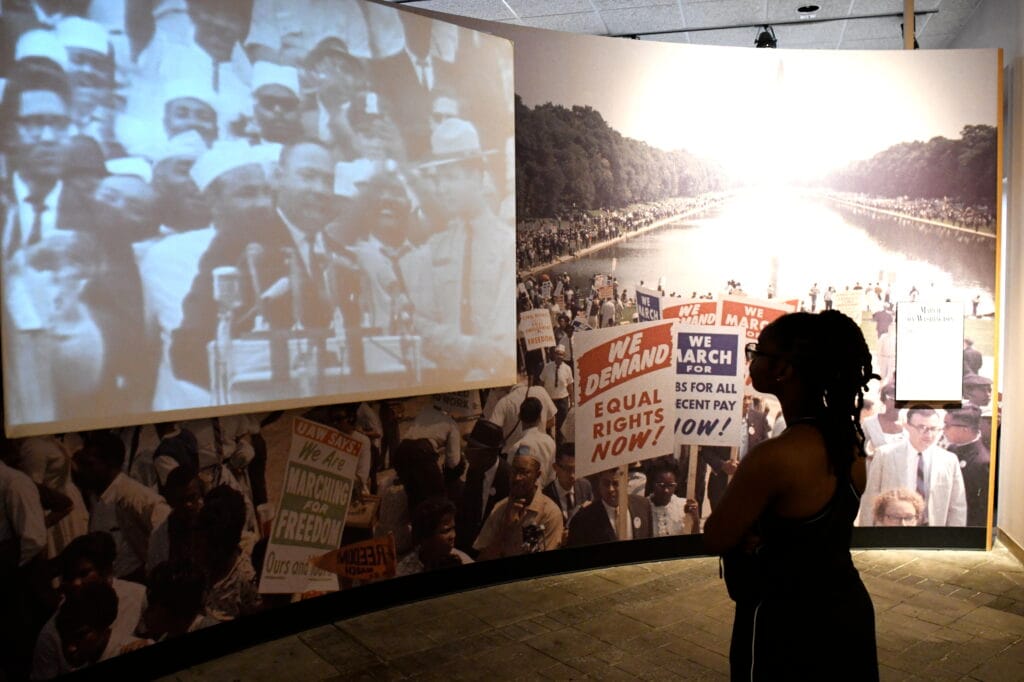
PICTURED: JaineenSmith is silhouetted against an exhibit, which includes Martin Luther King's "I Have a Dream" speech given at the March on Washington in 1963, featured at the Birmingham Civil Rights Institute.
Meagel Amollo is a first-semester student from Kenya. He is very knowledgeable about the United States and finds its culture and history fascinating. “I like to be aware of things happening around the world,” he said. “When you come somewhere, like I have come to Wilmington and America, you should try to learn about that place. It was a very big opportunity for me to be on this trip.”
Murdock has offered a Spring Break Civil Rights Tour since he took over the position 10 years ago. “These trips plant seeds,” he said. “It’s exciting and sobering to see the students’ reactions to places like the Lynching Museum. It was great to see everybody take it in and show respect. It’s not easy to look in the mirror.” He hopes the younger generation will take what they learned and how they felt and “do something to help someone out — do something every day.
“We’ve got to be the light!”
PICTURED AT THE TOP OF THE PAGE: The Wilmington College contingent walked across the Edmund Pettus Bridge in Selma, Alabama, where 61 years ago African Americans marching for their civil rights, from Selma to Montgomery, were beaten, tear gassed and attacked by vicious dogs. The group includes, from the left: FRONT ROW — KaMylia Mann and Jaineen Smith; MIDDLE ROW — Rose Bothast-Revalee, Gracie Blackburn, Brittanie Clair and Emily Winkleman; BACK ROW — Jack Robinette, Daniel McCamish, Ashton Harris, Meagel Amollo, Kellen Strayer, Darrick Perdue, De'Anta Sanon and Chip Murdock.