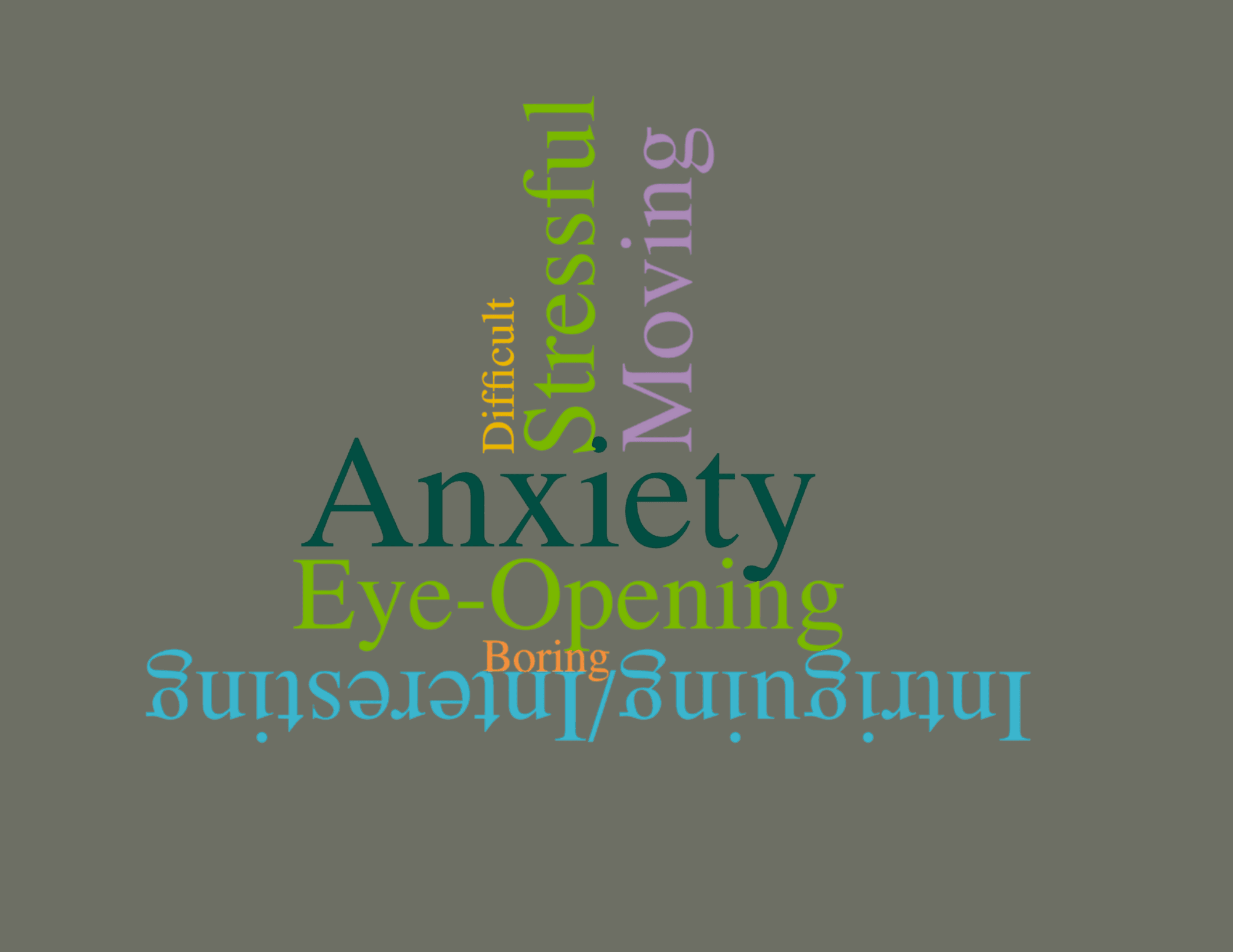
Every Fall, students enrolled in Dr. Audrey Wagstaff’s “Mass Media in a Global Society” course at Wilmington College are asked to do the unthinkable. To give up their devices for 24 hours, write about the experience, and connect how they felt, coped, and endured to concepts they learned about throughout the semester.
“The course focuses heavily on the role of [mass] media in shaping our lives – our communication and our relationships with ourselves and one another,” Wagstaff, a Professor of Social Science and Communication Arts said. “Thus, this project gives the students a chance to consider their lives without media and without technology.”
Most students opt to give up their mobile phones – a minimum requirement, Wagstaff indicated. Some see exclusion at its purest form and give up all media, down to the radios in their cars.
“I know that the vast majority of the students dread this project,” Wagstaff said. “So, not surprisingly, they procrastinate and just keep putting it off, filling the time they could be spending without their devices and working on this or another project with, ironically, more time on their devices. Thus, on the day before our Thanksgiving break, I remind them about the project one final time, showing a photo of people gathered around a Thanksgiving table, but all on their own phones. I then cross out the photo, she continued. “Don’t be these people, I say. Use this holiday break to reconnect face-to-face with your family and friends and WITHOUT your devices. You might be surprised how much more connected you feel.”
The project, which is inspired by with work of author Sherry Turkle required that the students look at their own media use more mindfully. In fact, the students in the class read Turkle’s 2015 Bestseller Reclaiming Conversation: The Power of Talk in the Digital Age.
As Turkle writes, “What phones do to in-person conversation is a problem. Studies show that the mere presence of a phone on the table (even a phone turned off) changes what people talk about. If we think we might be interrupted, we keep conversations light, on topics of little controversy or consequence,” Turkle writes. She also reminds us: “Every time you check your phone in company, what you gain is a hit of stimulation, a neurochemical shot, and what you lose is what a friend, teacher, parent, lover, or co-worker just said, meant, felt.”
“The paradox is that while our devices are luring us away from real, deep, meaningful, emotional connections with people, they are tempting us with little temporary bursts of satisfaction by exploiting our fear of missing out (FOMO), catering to what they think we want based upon algorithms build up on search histories, and temporarily curing our boredom or loneliness,” Wagstaff said. “What we end up with is surface-level.”
Many students reported noticing, in the absence of their devices, how much time they spend on their phones. They describe it has habitual and even instinctive to reach for their phones.
As one student articulated “The whole experience helped me understand how much of the media I use is more emotional rather than practical.”
Students also report having sans-phones experiences for the first time. One student frustrated her family when they became separated while shopping. “The funny thing was that after I accidentally got separated from my sister, I didn’t even know where to look for her since I didn’t have a phone. Luckily, we ran into each other later; otherwise, I probably would have had to ask the front desk for help.” Later, after her mom attempted to call her multiple times, clearly annoyed, the student reflected “In that moment, it became clear that media creates a mutual dependence. Even a small separation from it makes its influence unmistakably apparent.”
Another student reported having to really plan ahead for a trip to Kings Island – without a digital pass.
“Our phones have become an all-access pass,” Wagstaff said. “Concert tickets, museum passes, greeting cards…nothing is tangible anymore.”
Wagstaff, nonetheless, still asks them to bring a copy of Turkle’s book to class.
“Many of these students come wondering why I would ask them to read a 10-year-old book in a media class,” Wagstaff said. “What were you doing 10 years ago?, I ask them. Think about how much our collective dependence upon media has grown exponentially in those ten years.”
In Turkle’s chapter entitled “Family,” she writes about the impact of technology on families, on children, and on family dynamics, interviewing children and adolescents who complain that they want their parents back, writing that at one child’s home, “eyes are often down and mealtimes silent…the silences between with her mother breaking her own rule that there are no phones at meals. Then, with her mother’s phone out, there is a ‘chain reaction’” with… “children learning that no matter what they do, they will not win adults away from technology.”
“The children Turkle writes about are your age now,” Wagstaff tells her students, sometimes reading excerpts from her battered copy of the text in class. “What would Turkle say now? Are you leading the life your parents have modeled?”
One student reflected on Turkle’s concept of catastrophe culture, noting that Turkle’s “concern is that younger generations have developed a constant belief and dread that if they don’t have their phone nearby, then they may miss an urgent message from their loved ones or be unable to call for help during an unexpected emergency,” the student wrote. “I admit that at times I’ve had this ideology, and I know that many of my friends suffer from the extreme paranoia that something terrible will happen if they don’t check their Snapchat notification. By planning my 24-hours the way I did, I completely proved Turkle’s point without realizing it! I assume that this planning was likely also considered by my classmates; finding the ‘perfect’ time to cut off all media access to avoid as much ‘disaster’ as possible. They also likely applied this catastrophe culture subconsciously, just like I did. This made me begin to realize that this assignment was about to be a hard slap of reality.”
During the cleanse, students also report that they experience the paradox of initial panic and eventual peace. Picking up their phones to check social media or text messages is essentially habitual.
As one student wrote as soon as she woke up on cleanse day, “Already, I was struggling at nine in the morning because I broke my routine. Breaking a routine triggers both mental and emotional reactions. Our brains rely on structure; when we move out of step with this, we can potentially feel disoriented and ungrounded.”
But even in a 24-hour period, students who stick with it begin to see more of the world around them and feel less compelled to grab their phones.
As student described, “As the day went on, I began to realize how much social media messes with my peace.”
Another student described the transition, writing “My day moved a lot slower than usual, but in an almost peaceful way. It was hard because I felt disconnected, but the quiet helped me reset mentally. I also realized how much I check my phone for no purpose, but more out of habit. This showed me how deeply the media is almost built into my everyday life. Without having to see any notifications, I had to actually sit with my thoughts which felt both uncomfortable but grounding at the same time.”
“Reading these mini epiphanies brings me great hope that these students are developing critical media literacy skills and that they are becoming more mindful about their own media use and consumption,” Wagstaff said. “Perhaps this realization will linger.”
In an exit poll, 74% of students in the course indicated they would do the exclusion project again, albeit perhaps for a short time period.
As one student concluded, “I hope that other people can find the willpower to just take one day in their year to try to stay away from the blinding screens and try to find more joy and motivation from the people and resources around them.”